
Apostille First, or Translate First? The Correct Order for Foreign-Language Documents

Updated: Sep 7
A practical guide for immigration filings, cross-border transactions, and legal documents
The Short Answer: Apostille and Translation Order Matters
In almost every case, you should apostille the original document first, then translate it. After that, translate everything—the document body and the apostille certificate attached to it—unless the receiving authority tells you otherwise in writing. The reverse order (translate first, then apostille) is the most common and expensive mistake in international document preparation. It often leads to paying for the translation twice.
However, "apostille first" is a default, not a law. There are exceptions where a second apostille is needed on the translation itself and where the translation must be done in the destination country by a government-authorized translator. Both scenarios are covered below.
Why Does the Order of Apostille and Translation Matter?
People often treat "apostille" and "certified translation" as two steps in one process. They are not. They are two unrelated legal instruments that happen to travel together.
An apostille authenticates a signature—not content. Under the Hague Convention of 5 October 1961, an apostille certifies three things: the authenticity of the signature on the document, the capacity in which the signer acted, and the identity of the seal or stamp. It does not certify that the facts in the document are true, nor does it certify that any translation is accurate. Only the designated Competent Authority in the country where the document was issued can issue it.
A translation makes content readable—it carries no authentication. A translation is a private work product. In the United States, it becomes legally usable through a signed certificate of accuracy from the translator. In most civil-law countries, it is made legally usable by being produced by a sworn or court-appointed translator whose authority comes from the state.
Now the reason the sequence follows from this:
The apostille can only attach to a public document from its own country. A translation produced by a private translator is not a public document in the issuing country. Most Competent Authorities cannot apostille it directly; they can only apostille a notary's signature on the translator's affidavit, which is a different and slower path.
The apostille adds new text that usually has to be translated. The apostille certificate contains a country name, the signer's name, an official capacity, a place, a date, a certificate number, and an issuing authority. Many foreign registries and courts require that page to be translated too. If you translate before the apostille exists, your translation cannot possibly include it, and you will be sent back to the translator.
The apostille binds to one specific physical or electronic copy. It does not transfer to a replacement copy. If you translate a document first and then discover the receiving authority wants a freshly issued certified copy instead, both the apostille and the translation become invalid. Order the correct original first, authenticate it, and translate only the final version.
What Does the Receiving Authority Require?
Requirements are set by the receiving institution—the foreign civil registry, consulate, court, university, ministry, or corporate registry—not by the apostille office and not by the translator. Two consulates of the same country can differ. A university and a court in the same city can also differ.
Email or call the receiving office and ask these five questions:
Do you accept a certified copy, or must it be an original issued within the last X months?
Must the translation be done by a sworn/official translator registered in your country, or do you accept a certified translation from abroad?
Must the apostille certificate itself be translated?
Does the translation itself need to be notarized and apostilled separately?
Do you accept an electronic apostille (e-Apostille), or must it be paper?
Get the answer in writing and keep it. If the file is later questioned, that email is your defense.
Which Country Issues the Apostille?
This trips up more people than the ordering question does. An apostille is always issued by the country where the document was born—not the country where you live or the country where you're going.
Mexican birth certificate → apostille from the Mexican state authority. The U.S. cannot apostille it.
Ohio birth certificate → apostille from the Ohio Secretary of State. Italy cannot apostille it.
FBI background check, IRS letter, Naturalization Certificate → these are federal U.S. documents, so the apostille comes from the U.S. Department of State Office of Authentications in Washington, D.C., not from a state.
Sending the wrong document to the wrong authority is the second most common failure after wrong ordering.
Scenario A: The Standard Workflow
This covers roughly 80% of real cases: a public document going from a Hague member country to another Hague member country.
Step 1: Obtain the Correct Original
Order a certified copy from the issuing authority (vital records office, court clerk, registrar, university registrar). Not a photocopy, not a hospital souvenir birth certificate, and not a scan. Many countries require the copy to have been issued within the last 3 to 6 months—check before ordering.
Step 2: Add Any Intermediate Authentication Required
Some documents need a notary or a county clerk before the state will touch them. Vital records usually do not. In most U.S. states, having a notary stamp a certified birth certificate will get the whole packet rejected because the notary is not authenticating a signature they witnessed.
Step 3: Obtain the Apostille
From the Competent Authority in the issuing country. Do not remove staples, do not laminate, and do not separate the apostille page from the document at any point afterward. A detached apostille is worthless.
Step 4: Translate the Complete, Final, Apostilled Packet
Instruct the translator explicitly: translate the document body, all seals, all stamps, all handwritten annotations, all marginal notes, and the apostille certificate. Nothing is skipped. Illegible marks are annotated as illegible rather than omitted.
Step 5: Attach the Translator's Certification
A signed statement identifying the translator, confirming the translation is complete and accurate, and confirming the translator is competent in the language pair.
Step 6: Submit Original + Apostille + Translation + Certification as One Packet
In this workflow, the translation does not get its own apostille. That is the normal case.
When Does the Translation Itself Need to Be Apostilled?
Some countries and consulates will not accept a foreign translation unless the translator's signature has itself been authenticated. This creates a second, parallel chain.
Sequence:
Apostille the original document (Steps 1–3 above).
Translate the document and the apostille.
The translator signs the certificate of accuracy in front of a notary public. The notary is authenticating the translator's signature, not the translation quality.
Submit the notarized translation to the Secretary of State (or equivalent) for a second apostille—this one authenticates the notary.
Bind the two packets together and submit.
You end up with two apostilles: one on the original record and one on the notarized translation. This is legitimate and sometimes mandatory. It is also roughly double the time and cost, which is why you confirm the requirement before starting rather than doing it "just in case."
Watch for a trap here: a Competent Authority will only apostille a notary whose commission it can verify. If the translator notarizes in one state and you send the packet to another state's Secretary of State, it will be rejected.
When the Destination Country Requires Its Own Sworn Translator
Countries like Spain, Italy, France, Germany, Brazil, Colombia, and Poland maintain official registers of sworn translators (traductor jurado, traduttore giurato, traducteur assermenté, vereidigter Übersetzer, tradutor juramentado). A sworn translator's stamped translation is itself an official act in that country.
In these jurisdictions:
A U.S.-style "certified translation with notarized affidavit" is often not accepted, no matter how many apostilles are stacked on it.
The translation must be produced in the destination country after the apostille is already on the document.
The sworn translator's stamp replaces the need for a second apostille entirely.
Sequence: Obtain original → apostille in issuing country → ship or upload to a sworn translator registered in the destination country → sworn translation produced covering document + apostille → submit.
Do not commission a translation at home first. In this scenario, it has no legal standing where you're going, and the money is simply gone.
Non-Hague Countries: Consular Legalization
Roughly 190 countries exist; about 130 are Contracting Parties to the Apostille Convention as of 2026. Recent additions include China (2023), Canada (2024), Rwanda (2024), Bangladesh (2025), Algeria (in force July 2026), and Vietnam (in force September 2026), with Thailand scheduled for February 2027. Some significant markets are still outside—Canada joined only recently, and countries in the Gulf and parts of Africa and Asia remain non-members.
For a non-member destination, there is no apostille. There is a legalization chain, and each link must be completed in order:
Notary (if the document is private rather than public)
County clerk (in some U.S. states)
Secretary of State of the issuing state
U.S. Department of State, Office of Authentications
Embassy or consulate of the destination country
Where does translation fit? Usually at the embassy stage, and usually on the embassy's terms. Many consulates require the translation to be done by a translator they approve—sometimes an in-house or contracted translator—and they will legalize the translation alongside the document. Some require the translation submitted with the packet at step 5; a few require it earlier. There is no universal rule here. Ask the specific consulate. Their instruction sheet governs.
Budget four to twelve weeks for a full legalization chain, and longer if the consulate is backlogged.
Does USCIS Require an Apostille on a Foreign Birth Certificate?
This deserves its own section because it costs applicants real money every day. USCIS does not require apostilles. For documents submitted to U.S. Citizenship and Immigration Services, the governing rule is 8 CFR § 103.2(b)(3). It requires a full English translation plus a signed certification from the translator stating that the translation is complete and accurate and that the translator is competent to translate from that language into English. That's it.
The regulation does not require:
An apostille on the foreign document
Notarization of the translation
A "sworn," licensed, or government-approved translator
Membership in any professional association
If you are filing an I-130, I-485, N-400, or similar and you paid for an apostille on a foreign birth certificate purely for USCIS, you paid for something the agency neither requires nor examines.
Two Practical Cautions That Do Matter:
Completeness. Every stamp, seal, marginal note, and handwritten annotation must be translated or annotated. Partial translations are a leading cause of Requests for Evidence.
Independence. Although the regulation doesn't literally forbid it, USCIS routinely rejects translations done by the applicant or an interested family member as a conflict of interest. Use an independent third party.
When Immigration-Adjacent Documents Do Need Apostilles:
A U.S. document going abroad—a U.S. birth certificate for a dual-citizenship application in Italy, a single-status affidavit for a marriage in Japan, a police clearance for a residence permit in Spain.
Consular processing where a foreign civil registry (not USCIS) is the receiving party.
Intercountry adoption, which almost always requires apostilled home-study and clearance documents.
U.S. state and federal courts—unlike USCIS, courts commonly want the translation both certified and notarized.
The rule of thumb: apostille is for documents leaving the country, not for documents arriving.
Quick Reference by Document Type
Document | Typical path | Watch out for |
Birth / marriage / death certificate | Certified copy from vital records → Secretary of State apostille → translate | Never notarize a certified vital record; many countries require issuance within 3–6 months |
Divorce decree / court judgment | Certified copy from court clerk → clerk or state authentication → apostille → translate | Must be the final decree with the judge's signature and clerk's certification |
FBI background check | FBI-issued → U.S. Dept. of State apostille (federal, not state) → translate | Going to a state Secretary of State is an automatic rejection; check validity window (often 3 months) |
Diploma / transcript | Registrar-signed original → notarized registrar signature → county (if required) → state apostille → translate | Many countries also want the degree verification, not just the diploma |
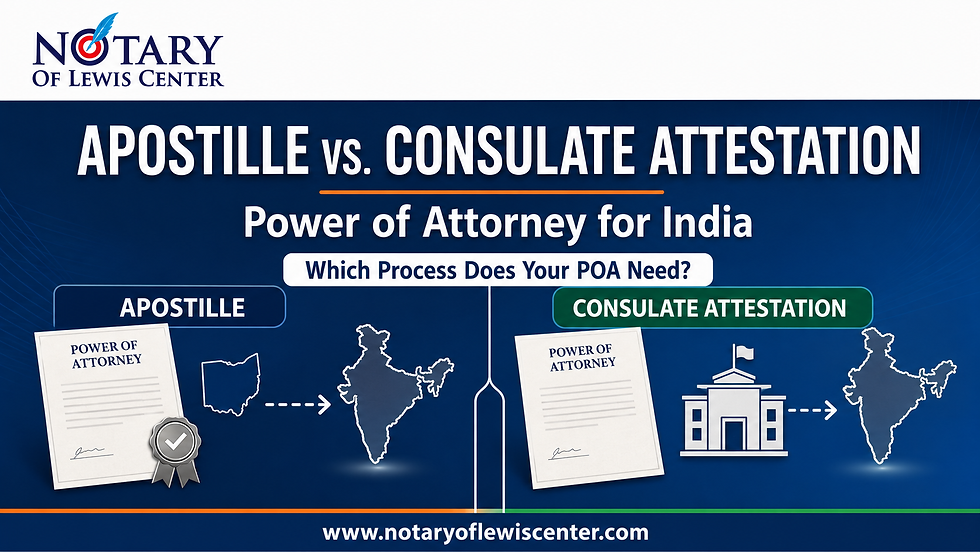
Power of attorney | Drafted → signed before notary → county (if required) → state apostille → sworn translation abroad | Destination-country civil-law form requirements often differ; have it drafted to their format |
Corporate documents (articles, good standing, board resolutions) | State-issued certified copy → state apostille → translate | Good-standing certificates expire quickly; sequence them last in a deal timeline |
Ten Mistakes That Cause Rejection
Translating before the apostille exists — the translation won't cover the apostille page.
Translating a document version you later replace — apostilles and translations both bind to one specific copy.
Apostilling in the wrong country — only the issuing country can apostille.
Federal vs. state confusion — FBI checks and naturalization certificates go to the U.S. Department of State, not a state office.
Notarizing a certified vital record — invalidates the packet in most U.S. states.
Laminating — voids the document permanently. Never laminate anything you may need officially.
Detaching the apostille — the staple or binding is part of the certification. Removing it breaks the chain.
Partial translation — skipping stamps, seals, or marginal notes.
Family-member translations — conflict of interest; rejected by USCIS and most courts.
10. Using an expired document — many registries reject vital records older than three or six months even though the underlying facts never change.
How Long Does an Apostille and Translation Take?
Work backwards from your deadline and add buffer time at every stage:
Ordering a certified copy: a few days to several weeks, depending on the jurisdiction.
State-level apostille: typically 1–3 weeks by mail; same-day walk-in in some states.
U.S. Department of State (federal): historically several weeks to a few months.
Certified translation: 1–5 business days for standard civil records.
Sworn translation in destination country: 3–10 business days, plus shipping.
Consular legalization (non-Hague): 4–12 weeks for the full chain.
Apostille fees are usually modest per document; the real costs are shipping, courier services, expedited processing, and—most of all—redoing work that was sequenced incorrectly.
Note on e-Apostilles: the HCCH's e-APP program is expanding, and a growing number of jurisdictions issue electronic apostilles verifiable through an online register. These can compress timelines dramatically. But acceptance is uneven—confirm with the receiving authority before relying on one, because some registries still demand wet ink and physical seals.

Bottom Line
Authenticate first, translate second, and translate the authentication too. The apostille is a statement about a signature that already exists on a document. It cannot be issued in advance, it cannot be moved to a different copy, and it cannot be applied to a translation that no official signed. The translation is the last thing you produce because it has to describe the finished, authenticated document—including the apostille that was added to it.
The only step that reliably comes before all of this is the one most people skip: getting the receiving authority's requirements in writing. Twenty minutes of asking prevents weeks of redoing.
This article is general information about document authentication procedures, not legal advice. Requirements vary by country, by institution, and over time. For a specific immigration filing, court matter, or transaction, consult a qualified immigration attorney or the receiving authority directly, and verify current Convention membership against the official HCCH status table at hcch.net.

Comments