
Apostille or Consulate Attestation for a POA Going to India?

Updated: Aug 22
If you're an NRI anywhere in the United States preparing a power of attorney to send home — to let your father sell a flat, your brother handle a bank account, or an advocate appear in court — you'll hit this question immediately. And you'll get contradictory answers from friends, WhatsApp groups, and most of the internet.
Here's the straight version, including the parts most people get wrong.
The short answer
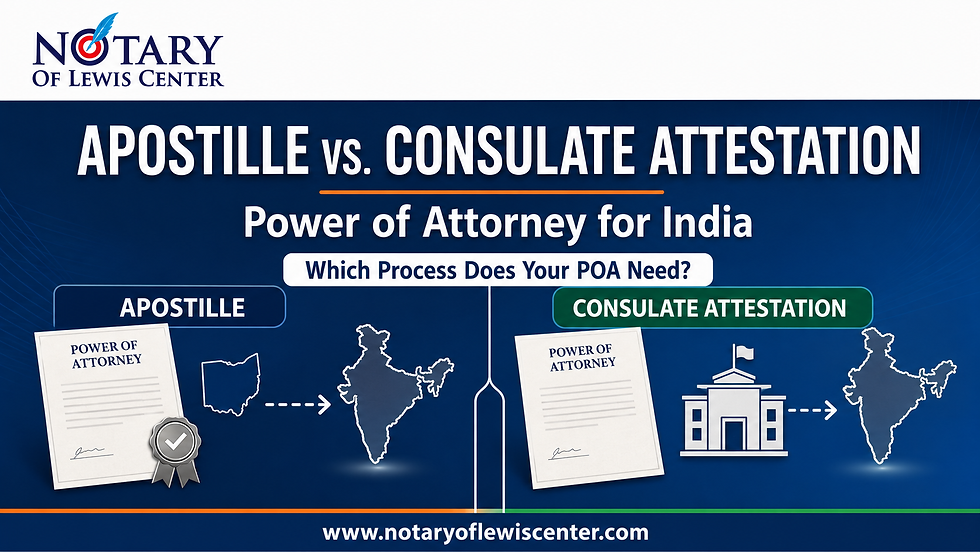
For most powers of attorney going from the United States to India, an apostille from the Secretary of State of the state where the document was notarized is the correct route.
India and the United States are both parties to the 1961 Hague Apostille Convention. Under that Convention, a document bearing an apostille is entitled to recognition in India, and no certification by the Consulate is required. That's not our interpretation — that's how the Indian consulates describe it themselves.
So in theory, the question is settled.
In practice, it isn't. Acceptance varies enormously depending on what the POA is for and who is receiving it — and that variation is predictable enough to plan around
What an apostille actually does — and doesn't do
This is the part that trips people up, and it matters more than the apostille-versus-attestation question.
An apostille is a certificate issued by a state's Secretary of State verifying the signature and seal of a notary or official commissioned in that state. That's it. An apostille only certifies the origin of the document — the authenticity of the signature or seal and the capacity in which it was signed. It does not certify the content of the document.
Read that twice, because it's the single most misunderstood thing in this process.
An apostille does not mean your power of attorney is validly drafted. It does not mean it contains the right clauses for your transaction. It does not mean the Indian authority will accept its substance. It confirms one narrow thing: that the notary who stamped it is a real, commissioned notary in that state.
Everything about whether the document works — format, wording, stamp paper, the powers granted, and the registration and stamp duty steps on the India side — belongs to your advocate in India. An apostille is a passport for the signature, not a warranty on the contents.
Which route does your transaction need?
The single most useful question isn't "apostille or attestation?" It's "who has to accept this document?" Here's how the answer tends to break down.
Buying property with a home loan — the strictest case
If a bank is lending against the property, the bank sets the rules, and lenders are far stricter than registrars.
This is especially true of public sector banks. Many publish their own mandatory POA format, and that format leaves no room for interpretation. The State Bank of India's NRI power of attorney form, for instance, states directly that where the document is executed in a foreign country, it should be attested only by an Indian Embassy, Consulate or High Commission, and that the executant should sign the POA in front of an official of the Indian Embassy, Consulate or High Commission in the country where they reside. Other lenders publish similar language — Dhanlaxmi Bank's NRI home loan FAQ requires that the grantor's signature be attested by an authorised official of the Indian embassy, consulate or trade commissioner in the country of residence.
Practical takeaway: if a public sector bank loan is involved, plan for consular attestation from the start. Assume an apostille alone will not clear the lender's file. Get the bank's own POA format before you sign anything — banks routinely reject documents that aren't on their prescribed form, no matter how they were authenticated.
Selling property — usually the most flexible case
Where there's no lender in the picture and the POA is being used to execute a sale, the deciding authority is the sub-registrar's office. Practice here varies widely by state and even by individual office. Some registrars will accept a POA that carries only a foreign notary's seal, provided the India-side stamping and registration steps are properly completed. Others want more.
Practical takeaway: this is the scenario where it's genuinely worth having your advocate call the specific sub-registrar's office before you spend money on authentication. The answer for a sub-registrar in one district may not hold in the next one, and familiarity with apostilles varies from office to office depending on how often they handle documents from abroad. Where you can't get a clear answer, consular attestation is the more conservative choice.
Banking, court and other matters
For NRE/NRO accounts, PPF, demat, mutual funds, and most court filings, requirements are set institution by institution. Ask the specific branch or advocate.
The rule underneath all of this
Ask the office in India that will actually receive the document. Not us, not a WhatsApp group. The specific bank branch, sub-registrar, or advocate handling your matter. Five minutes on a call to India saves three weeks and a re-do.
If you can't get a clear answer, consular attestation is the more conservative choice. It takes longer and costs more, but it's accepted essentially everywhere an apostille is, plus the places an apostille isn't.
US citizen without OCI? You need both — in the right order
This is the single most expensive mistake we see, and it has nothing to do with your property or your bank. It depends on which passport you hold.
The Indian Embassy's own power of attorney guidance states it directly: applicants of other nationalities must first get the PoA apostilled by the US State Department or authorities, and the Embassy will attest the PoA for such applicants only after it has been apostilled. The apostille is obtained from the office of the Secretary of State in the state where the applicant resides.
And the exemption: there is no need for the PoA to be apostilled for OCI or PIO card holders — those applicants follow the same procedure as Indian nationals and enclose a notarized copy of the OCI or PIO card with the application.
So, plainly:
Your status | Path to consular attestation |
Indian passport holder | Notarize → Consulate attests |
US citizen with OCI or PIO card | Notarize→ Consulate attests (enclose notarized OCI/PIO copy) |
US citizen without OCI or PIO | Notarize → Apostille → Consulate attests |
If you surrendered your Indian passport and never applied for OCI, you are in that third row. Your POA needs the apostille before it goes to the consulate — not instead of consular attestation, and not after. People in this category routinely send a notarized POA straight to VFS, get it returned, and lose three weeks.
Worth noting: this is one of the more practical arguments for getting an OCI card if you don't have one. It doesn't just simplify travel — it removes a step, a fee, and a week or more from every consular document you'll ever file.
One more step nobody warns you about
Authentication in the U.S. is not the end. A POA executed abroad generally has to be stamped in India after it arrives —stamped at the District Registrar's office within 90 days of receipt is the commonly cited requirement, and bank documentation frequently specifies that stamp duty be paid in India within three months of receipt and before the loan documents are executed. Miss that window and the authentication work you paid for may not save the document.
Your advocate handles this part. Just know it's coming, and don't let the POA sit in a drawer in India for four months.
If you need consulate attestation: the 2025 jurisdiction changes
Mission | States and territories covered |
Washington, DC | Bermuda, District of Columbia, Kentucky, Maryland, North Carolina, Virginia, West Virginia |
Atlanta | Alabama, Florida, Georgia, Mississippi, Puerto Rico, South Carolina, Tennessee, Virgin Islands |
Boston | Maine, Massachusetts, New Hampshire, Rhode Island, Vermont |
Chicago | Illinois, Indiana, Iowa, Michigan, Minnesota, Missouri, Wisconsin |
Houston | Arkansas, Kansas, Louisiana, Oklahoma, Texas |
Los Angeles | Southern California (Los Angeles, Orange, San Diego, Imperial, Riverside, San Bernardino, Ventura, Santa Barbara, Kern, San Luis Obispo counties), Arizona, Nevada, New Mexico |
New York | Connecticut, Delaware, New Jersey, New York, Ohio, Pennsylvania |
San Francisco | Northern California (the 48 counties outside the Los Angeles jurisdiction), Guam, Hawaii, Utah, Colorado, Wyoming |
Seattle | Alaska, Idaho, Montana, Nebraska, North Dakota, Oregon, South Dakota, Washington |
The U.S.-side steps, in order
Whichever route you end up on, the American side looks broadly the same:
1. Sign in front of a notary. Your document must be signed in the notary's presence — not before. Signatures must be original; photocopies aren't accepted for apostille.
2. Notarize with a notary commissioned in your state. This matters: a state can only apostille documents notarized by its own notaries. If you're in New Jersey, a New Jersey notary and the New Jersey Secretary of State. You can't mix states.
3. Apostille from that state's Secretary of State. Procedures vary. Some states apostille a notarized document directly. Others require the county clerk to certify the notary's signature first — New York is the best-known example of this extra step. Check your state's Secretary of State website, or ask the notary handling your document.
4. Consulate attestation, only if required. Through the mission with jurisdiction over your state. Before you file, note what the checklist actually asks for:
The Embassy does not prescribe any specific format for a PoA
— it can be on plain paper or Indian stamp paper, as the applicant requires.
After signing, you affix a current passport-size photograph on the last page, and the PoA must then be signed and witnessed by two individuals who are not immediate family members, with their full names and addresses clearly stated.
Indian nationals must ensure their signature matches the signature in their current valid passport — if it differs, the document is sent back to be re-signed.
That two-witness requirement catches most people off guard, and "not immediate family" rules out the spouse sitting next to you.
Arrange them before your appointment.
A convenience worth knowing about: VFS accepts in-person submissions for CGI New York at several locations, including Columbus, Ohio, at 130, 100 E Campus View Blvd, Columbus, OH 43235 — alongside New York, Edison, and Boston. If you're in Central Ohio, you don't need to travel to New York.
5. Courier to India.
One practical note on timing: steps 1 and 2 are usually same-day. Steps 3 and 4 are not, and they're outside anyone's control but the government's. If you have a registration date booked in India, work backwards from it generously.
What we can and can't help with
We're notaries, not attorneys. That distinction is worth being blunt about, because plenty of people in this space are not.
We can: notarize your signature, obtain the apostille on your behalf, handle the consular submission, arrange witnesses, and come to you.
We can't: draft your power of attorney, tell you which format the sub-registrar will accept, advise on stamp duty or adjudication in India, tell you whether a GPA or SPA fits your transaction, or tell you which authentication route your recipient needs.
Those questions have real consequences if answered wrong, and they belong to your advocate. We'd rather send you back to them for ten minutes than have your document bounce in India three weeks from now.
Ready to start?
We serve clients throughout Central Ohio in person and mobile, and clients across the United States through Remote Online Notary where the destination accepts it. Tell us what you're sending and where it's going, and we'll tell you what the process looks like and how long it will take.
Notary of Lewis Center
Call or text (614) 438-5859 · Book online
Mon–Fri 4:30 PM – 9:00 PM · Sat–Sun 8:00 AM – 8:00 PM ET
Related: Apostille for Power of Attorney in Ohio · Remote Online Notary · Apostille Pricing · Apostille FAQ · OCI Application Support
Notary of Lewis Center is not a law firm and does not provide legal advice. Information here is general and current as of the date above; government procedures and consular requirements change. Please confirm requirements with your advocate in India, the authority receiving your document, and the Indian mission with jurisdiction over your state.


Comments